


View our full voter guide and state level endorsements here
While some of our endorsed ballot measures rely on regressive parcel or sales taxes, we know these are short-term fixes. To sustain our public infrastructure, build affordable housing, and fund the services our communities need for the long term, we need to tax the rich so that large corporations and billionaires contribute in proportion to their wealth.
In Oakland and San Francisco, Bay Rising and our endorsing partners are supporting changes to the Mayor’s authority in Oakland, but not in San Francisco. Why? Oakland’s charter reform proposals followed a community-based process with extensive input, in partnership with groups like the League of Women Voters. In San Francisco, the Mayor’s proposals come only from the Mayor, without deep community input, and would concentrate power in his hands.
Interested in learning more or taking action beyond election day? Check out Bay Rising’s Partner Organizations and related issue areas from our Solutions Springboard.
MULTI-COUNTY: ALAMEDA, CONTRA COSTA, SAN FRANCISCO, SAN MATEO, SANTA CLARA
Yes on Measure RTM: Reinvest in Regional Public Transportation
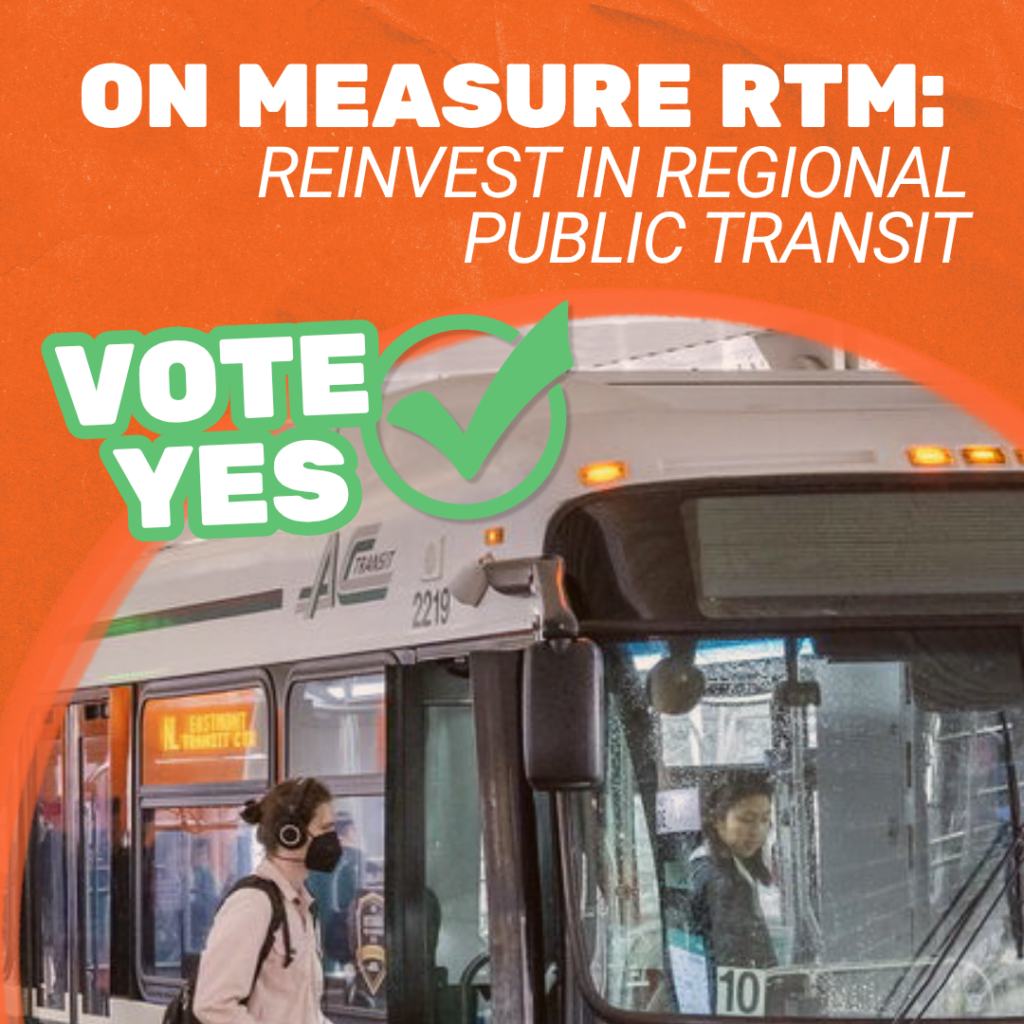
Many in the Bay Area depend on public transit to get to work, school, medical appointments, community events, and more. Without significant investments in public transit—AC Transit, MUNI, BART—our region’s traffic gridlock and commute times will balloon. After decades of underinvestment, public transit agencies in the Bay Area are facing severe financial crises. Measure RTM would enact a half-cent sales tax in Alameda, Contra Costa, Santa Clara, and San Mateo counties, and a 1-cent sales tax in San Francisco, for 14 years—providing $1B a year in new funding. Without this funding, public transit services would be cut dramatically: MUNI would cut services by at least 30%, AC Transit would reduce service by 16%, and BART would close 15 stations and cut service by 70%. An historic alliance of labor, business, and transit advocates coalesced to put this measure on the ballot after enabling legislation, CA Senate Bill 63 (Wiener, Arreguin), passed in 2025. An investment in public transit is an investment in a thriving economy, clearer air, and a more affordable region. Vote Yes on Measure RTM.
BERKELEY, ALAMEDA COUNTY
Yes on Measure Z: Generate Seed Funding for Public Banks
Under traditional banking practices, private, for-profit entities owned by investors loan money for projects at high interest rates. In contrast, public banks are owned by government institutions and can use taxpayer dollars to finance local projects such as affordable housing, clean energy, and other investments. Measure Z in Berkeley would charge a temporary parcel tax of 6 cents per square foot of residential improvements, or 9 cents per square foot of commercial improvements, for six years, generating $9.2 million per year. Public banks loan to local institutions like community banks and credit unions, and stipulate how the funds are used. Several cities are pursuing public banks following state legislation passed in 2020 that outlines the process for localities to create them. If passed, Berkeley would be the first public bank in California. Vote Yes on Measure Z in Berkeley.
OAKLAND, ALAMEDA COUNTY
Yes on Measure EE: Make City Hall Accountable to Oaklanders
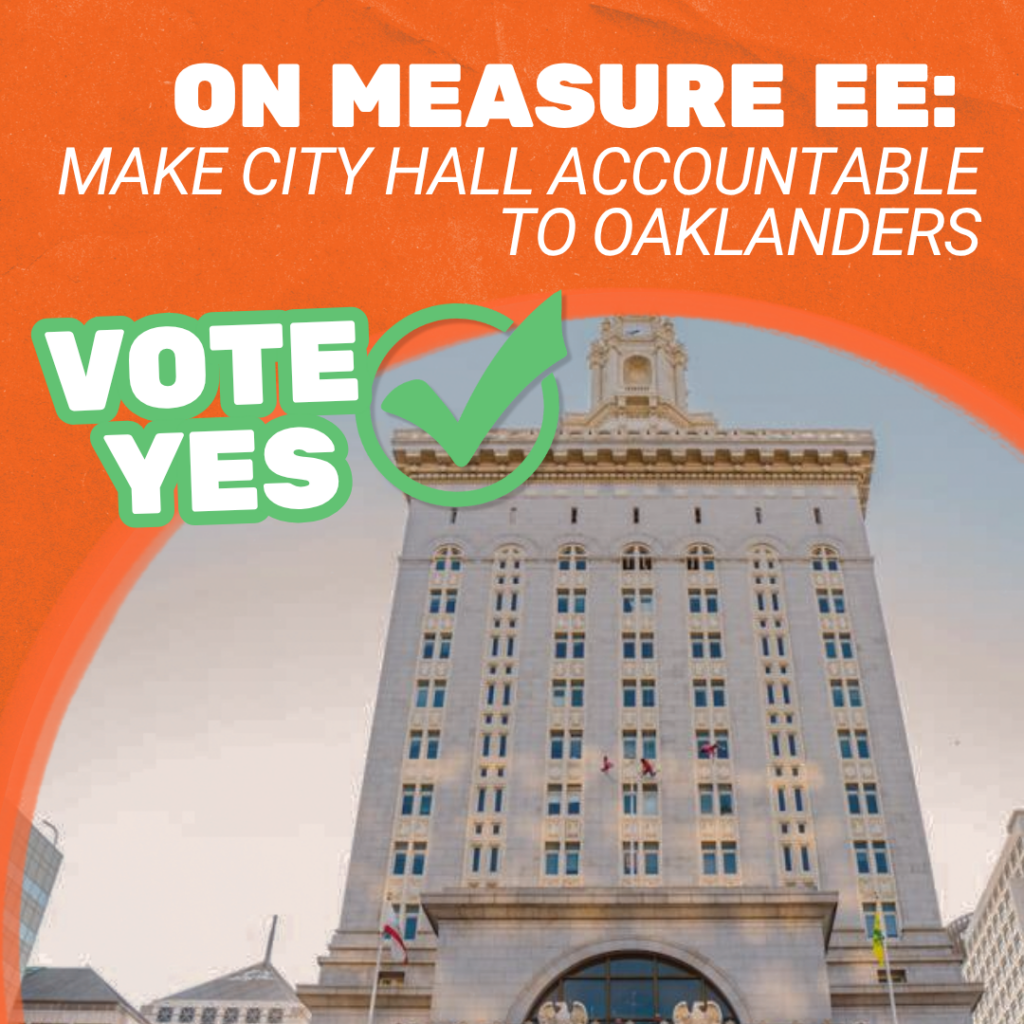
Currently, the City of Oakland operates under a “hybrid” system of government, where, too often, the blame for inaction leads to finger-pointing between the City Council and the Mayor. Measure EE is a charter amendment that clarifies the Mayor and City Council’s responsibilities, powers, and accountability structures. Under Measure EE, the Mayor serves as the Chief Executive Officer in Oakland, giving them veto power over legislation and line items in the budget. The city council can override a Mayoral veto with a supermajority, providing checks and balances between the legislative and executive branches of government. Measure EE was drafted after an extensive community process, co-facilitated by the League of Women Voters. Vote Yes on Measure EE.
SAN PABLO, CONTRA COSTA COUNTY
Yes on Measure S: Stabilize Rents and Protect Against Unjust Evictions.
All across the Bay Area, rents are rising faster than wages, and seniors, students, and families are uprooted in search of more affordable housing—endangering the stability and safety of our neighborhoods. Studies show that a $100 increase in median rent is associated with a 9% increase in an area’s homelessness rate. Measure S would create fair protections for renters in San Pablo by capping annual rent increases at 3%, protecting renters from unjust evictions, keeping families in their homes, and reducing homelessness. Under Measure S, nearly 391 mobile home residents, including many seniors, could receive protection against rent hikes that force them out of their homes and spaces. Exemptions apply to most newly constructed housing, and funding for administering rent control and rent protections comes from fees on landlords, similar to other cities. Landlords will still be able to make reasonable annual rent increases and seek fair rent adjustments when necessary. Vote Yes on Measure S in San Pablo.
SAN FRANCISCO
Yes on Prop B: Authorize creation of public bank
Our tax dollars are currently invested in and make money for big, private banks and their private shareholders, instead of the people of San Francisco. Banks currently invest our public dollars in harmful industries like fossil fuels, tobacco, the military, and weapons manufacturing. Commercial banks continue to deny our communities loans, support, and capital based on what we look like or where we come from. Prop B changes the San Francisco charter to authorize the creation of a Municipal Finance Corporation and Public Bank. A public bank would benefit San Franciscans by creating low-interest loans for city infrastructure and affordable housing, commercial loans through credit unions and community banks, and loans to drive community revitalization. Vote Yes on Prop B in San Francisco.
No on Prop D, E, F: Make Qualifying a Ballot Measure Harder, Strengthen Mayoral Power
Three propositions in San Francisco would dismantle our democratic processes and concentrate power in the hands of the Mayor and the conservative majority on the Board of Supervisors. All three measures are funded by a venture capitalist and a Trump megadonor. Prop D would make it harder for voters to have their voices heard by increasing the number of signatures a measure needs to reach the ballot. Ballot measures are an important way for the public to make direct change in our city and to tell the Board of Supervisors what we, as the public, want them to get done. Prop E slashes the authority and community oversight provided by the city’s commissions and replaces it with more Deputy Mayors in a bloated executive branch of government. Prop F gives the Mayor more powers vis-à-vis the Board of Supervisors by raising the threshold for Board approval and amendments of contracts, increasing the Mayor’s authority over contracts, and extending the City Administrator’s term from 5 to 10 years. Vote No on Prop D, E, and F in San Francisco.
Yes on Prop H: Stronger Muni Transit Operations
San Francisco’s public transit system is facing a once-in-a-generation funding crisis. After years of pandemic disruption and lost revenue, Muni is confronting a $307 million annual deficit—a shortfall so large it rivals the combined budgets of the city’s parks and library systems. Resulting cuts to Muni would worsen SF’s congestion and gridlock, which is already ranked the 3rd-worst in any major US city. Muni would cut service on 20 bus routes, canceling certain routes and doubling wait times. The Stronger Muni for All/Prop H would establish a tiered parcel tax on commercial and residential properties. Under the proposal, 95% of single-family residences would pay a flat $129 annually, with larger homes subject to progressively higher rates. The largest commercial properties would pay up to $400,000 annually, ensuring the biggest properties contribute the most. Vote Yes on Prop H in San Francisco.
Yes on Prop I: Ensure Luxury Real Estate Tax is Spent on Affordable Housing
San Francisco faces an affordable housing crisis that is displacing thousands of people from the city. In November 2020, San Francisco voters approved a transfer tax on high-value real estate transactions, with the expectation that these funds would support affordable housing and housing stability. Instead, these funds have been used for a variety of purposes because they currently go into the General Fund. Prop I dedicates an existing, voter-approved tax to fund permanently affordable housing and preventing displacement. Funds would be used to build new, permanently affordable housing, preserve and acquire existing housing, and provide tenant protections, eviction defense, and homelessness prevention. Vote Yes on Prop I in San Francisco.
REDWOOD CITY, SAN MATEO COUNTY
Yes on Measure E: Stabilize Rents and Protect Against Unjust Evictions
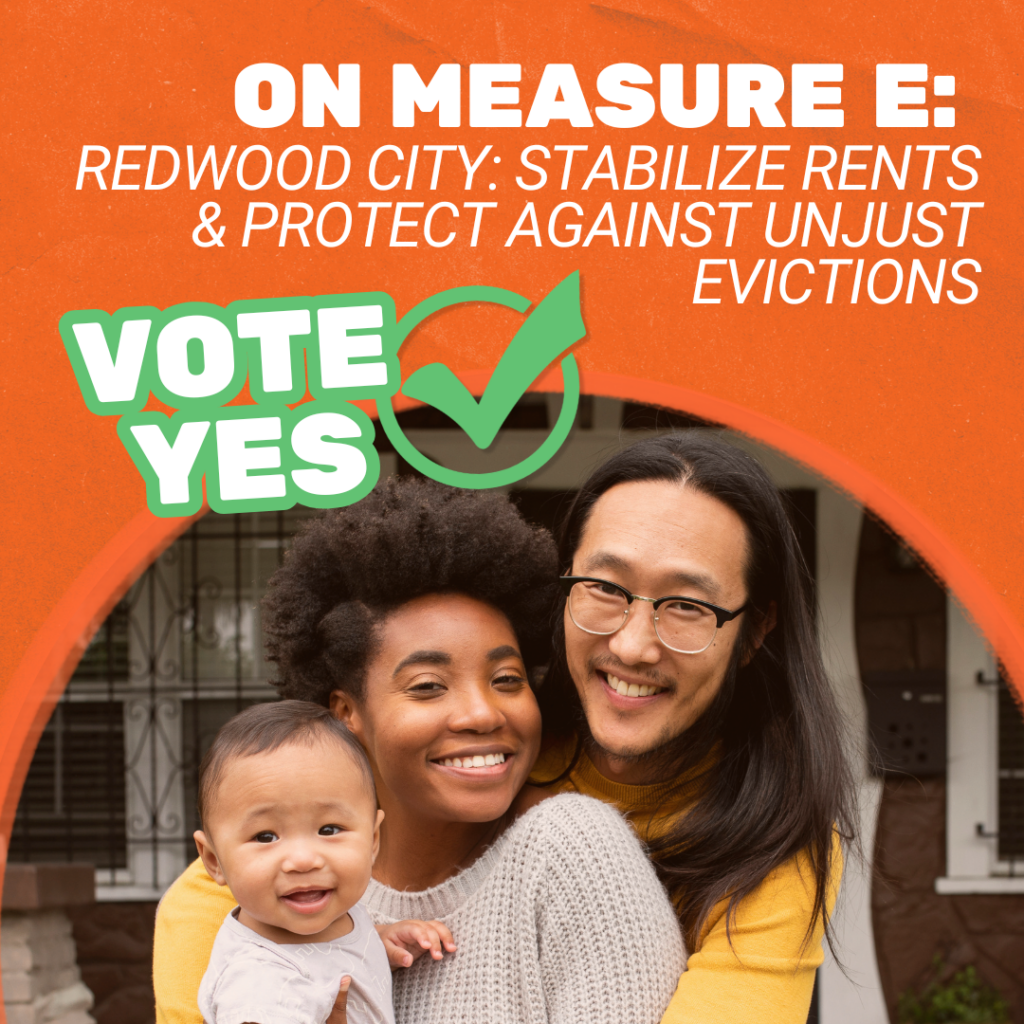
Half of Redwood City residents, including over 70% of Latino and Black households, are renters who pay an average of almost $4,000 for a 2-bedroom home. At the same time, 87% of multi-family rental units in Redwood City are owned by corporations and real estate trusts rather than small landlords. Measure E would strengthen protections for renters, including rent stabilization capped at 5% per year, with exemptions for single-family homes, condos, and all new units built since 1995. This measure would also strengthen just cause for eviction by requiring landlords to provide one of a list of approved reasons before evicting a tenant. The measure ensures healthy living conditions with the right for tenants to return after renovations, and safeguards against harassment of tenants by prohibiting the mistreatment and intimidation of tenants. The oversight and implementation of the measure includes community education, legal services, data collection, and support for tenants and landlords through the petition and hearings process. Vote Yes on Measure E in Redwood City.